Case study · Fusion / FSNEX
How Fusion's blockchain history was recovered
When Fusion's public infrastructure went offline, people lost access to the history of their own transactions. We found a node backup through the community, rebuilt FSNEX, and made all 15,130,081 recovered blocks searchable again.
What this recovery shows
- A complete recovered history, indexed from a node with no internet access
- Chain-specific behaviour handled, including Fusion's ticket mechanism
- Node software patched where historical tracing needed it
- A read-only API over the indexed records
Why FSNEX came back
FSNEX's creator, Alg Ore, had been a member of the Fusion community for years. When the foundation's infrastructure disappeared, he watched people in that community lose access to the history of their own transactions. He had used the chain himself and knew what those records were worth.
We wanted to give them a way to see that history again, and to export records for tax documentation and other cases where they need evidence of past activity. Rebuilding the old explorer was the practical way to do it.
Finding a backup
By September 16, 2026, we were asking in the Fusion and Chainge Telegram communities whether anyone still had a running node, a stopped node or a backup of its chain data.
On September 20, a long-time Fusion community member messaged us privately. They had a backup they could share, and its chain data went past the shutdown of the foundation's infrastructure. The recovered archive is built from that backup.
Rewriting the explorer
The biggest job was the application itself. The original FSNEX was written in JavaScript. We rewrote it as a full C# stack, the same stack we use for enterprise systems.
That rewrite became BlockGaze, the indexer and explorer behind the new FSNEX, designed to serve other EVM networks as well.
Indexing from an offline node
BlockGaze indexes the recovered chain from a node with no internet access. The indexer reads the history from that node and organises it for the explorer, so FSNEX answers searches without any of Fusion's former public infrastructure.
Patching the node software
To trace internal transactions in historical blocks, which the original explorer could not do, we had to patch efsn, the Fusion node software. When it replayed history, the node could lose Fusion's ticket state while reopening a processed block. The patch keeps the block's ticket commitment when it reopens that state.
The proposed fix and how it was checked are in a public pull request opened on October 11, 2026. It changes historical tracing only. Consensus validation and normal block import are unchanged.
15,130,081 recovered blocks
All transactional data in the recovered history is restored for blocks 0 to 15,130,080, from June 2019 to October 7, 2025 at 08:43:50 UTC. The last recovered block comes after the shutdown of the foundation's infrastructure.
Anyone can look up historical blocks, transactions and addresses, and follow token activity. A read-only API gives developers and researchers the same indexed records.
What the archive preserves
The archive gives access to recovered historical records. It does not restart the Fusion network or allow new transactions, and its history ends at the last recovered block.
Preserving Fusion's software
We also created the Fusion-Community GitHub organisation, which keeps forks of Fusion's software. The tools people used to work with the chain stay available for future reference.
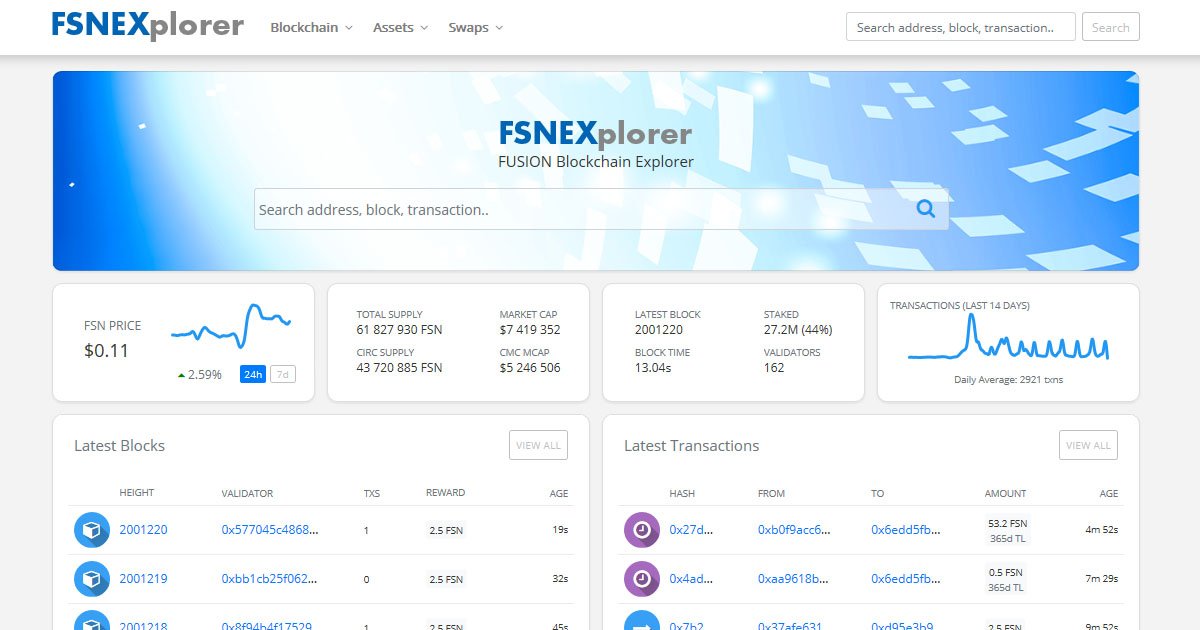
Continuity for the community
FSNEX kept its name
FSNEX kept its identity when we rebuilt it with BlockGaze. It now serves Fusion's recovered history as an archive.
The same rebuild lets the explorer run on other EVM networks too, including active public chains, private deployments and historical archives.
Explore blockchain archiving with BlockGazeInspect the result
The recovered history is open to explore
Open FSNEX to browse the archive or search for a Fusion address, block or transaction you already know.
Historical archive
Fusion, archived
The original FSNEX, rebuilt. Every recovered Fusion block is searchable, from genesis on.